
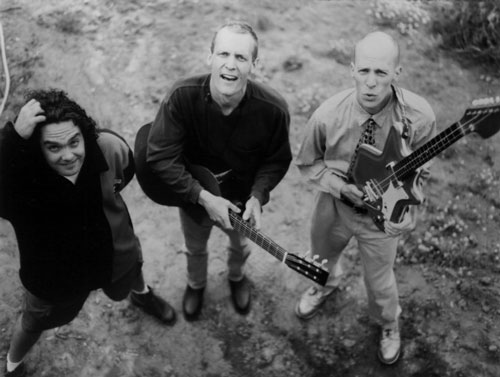
This series is about influential music and what it did to me. It’s inspired by Jeff Tweedy’s book World Within a Song: Music That Changed My Life and Life That Changed My Music. After Cherub Rock, I’m turning to Peaches.
If you were going to be a band in Seattle playing rock music right when the nineties were getting going, that might be about the best zip code and decade you could ask for. That’s where the Presidents found themselves. But while they were in grunge geography, they didn’t see themselves as part of the grunge scene. They were a pop band who just happened to live there. Their only similarity to grunge bands was perhaps flannel shirts.
The Presidents are another example of a rock act stretching the whole concept.
What is rock? How would you even define it? This band begs that kind of question. If rock carried some responsibility to be angry at something, the Presidents would be a counterpoint. If rock demanded brooding and dark emotions, the Presidents showed us a different way.
Everything is a joke to this band: a grandiose name while they saw themselves as musical nobodies; an instrumentation setup that was usually simple—a small, toy-like drum set, Chris Ballew’s two-string basitar, and Dave Dederer’s three-string guitbass. Their songs take on whimsical qualities like children’s stories. It’s no surprise Chris Ballew went on to write albums for kids (including as Caspar Babypants).
Not unlike a chef presenting a dish deconstructed so you can see its components, the Presidents feel like a deconstructed form of rock—the most basic elements. When the trajectory of rock seems to be bigger drums, heavier guitars, higher-gain amps, bigger attitudes, more shock value—the Presidents took part in none of that and still stood their ground.
The lyric idea for the song Peaches, the way Chris Ballew tells it in interviews, layers two memories. One was Boston: he was on LSD, went to a girl’s house to tell her he liked her, and found she wasn’t home—just a peach tree in the front yard. The other was Seattle—a homeless man at a bus stop, muttering about moving to the country and eating peaches on repeat. He took that bundle of images and wondered what it sounded like as a song. Dave Dederer wrote the outro—the section that shifts into its own rhythm after the second chorus—and Ballew has described the finished track as two songs welded together, a collaboration at the heart of one of their biggest hits. But what did that utterance mean? What kind of strange relay is Peaches through the universe? Regardless of the meaning, the Presidents used it to give people something to sing.
The video below is the official HD music video (YouTube upload Feb 2023 remaster).
This song means a lot to me because of the accessibility of it. The lead line can be played on a single string on the guitar. If you have an ear for music, you can easily pick this song out. This happened to me in my parents’ basement picking up my dad’s acoustic guitar. Peaches was one of the very first songs that I learned. The relay continued from a stranger’s overheard phrase, to real chart success for an unsuspecting band, to the acoustic guitar I held in my hand. Music weaves a strange and beautiful thread through our lives and finds us a community we didn’t know we needed.
There is brilliance in virtuosity, but there is also brilliance in bringing art to the people. These Presidents were certainly men of the people. Their goal was to have fun making music and to put a smile on people’s faces. They showed that less can be more. They showed that songs that move people don’t have to come from pain. Humans can conjure fire from two sticks and a rope. With a few more sticks and strings, the Presidents conjure fantastic musical worlds.
The Presidents showed me that no matter how weird you are, in the world of rock there is freedom to be yourself and it doesn’t have to be that complicated.
References
- Hero image — David Buck, Beyond “Lump”: The Presidents of the United States of America Rocked, Tedium, 29 Nov 2018. Figures the photo as a ’90s promotional shot of the band (“PUSA, in a ’90s promotional photo”). Source file
1129_pusaold.jpg—https://static.tedium.co/2018/11/1129_pusaold.jpg. Local copy for this site:/images/pusa-tedium-2018-promo-hero.jpg(500×377). Original photographer / rights not stated on Tedium; personal-blog use with link-back and credit to the article. - Song background, charts, and recognition (“Peaches”) — “Peaches (The Presidents of the United States of America song)” (Wikipedia): chart peaks (US Billboard Hot 100 29, Modern Rock Tracks 8, UK 8, etc.), 1996 Grammy nomination (Best Pop Performance by a Duo or Group with Vocal), band acknowledgement of Bad Company’s “Feel Like Makin’ Love” (1975). Andrew Leahey, “Behind The Song: PUSA’s Chris Ballew Talks ‘Peaches,’ Madonna and Disorientation” (American Songwriter, 16 Nov 2015): Ballew on Boston (peach-tree / LSD episode) and Seattle (bus-stop line), and on Dave Dederer writing the outro (“two songs welded together”). Note: Official credits often list Chris Ballew alone as songwriter; the interview still assigns the outro to Dederer.
- Stripped-down instruments (basitar / guitbass, two- and three-string rigs) — The Presidents of the United States of America (band), Wikipedia (accessed 2026); aligns with the “deconstructed” sound discussed above.
- Early reception / simplicity as artistic choice — Neil Strauss, “Pop Review / Simplicity and Also Crunch”, The New York Times, 21 Nov 1995 (review of the band’s debut era; useful contemporary framing of their minimal attack).
- Learning the riff on a standard guitar — Community transcriptions often map the hook to one or two strings in standard or drop-D-style tunings for beginners; see for example Ultimate Guitar, “Peaches” (chords / tabs) (user-submitted; not an official score—the recording reflects the band’s own tunings and basitar/guitbass setups per ref. 3).
- Official music video (HD) — The Presidents of the United States of America — Peaches (Official HD music video), YouTube upload dated 27 Feb 2023 (embedded above via youtube-nocookie).